Meridian Playout

Playout.
Frame perfect.

Broadcast automation built natively for macOS, small enough to run on a Mac mini. Every frame stays on the GPU. Every command lands on the frame it was meant for. And the whole channel runs in a browser.

See it

Every screen a channel needs.
In a browser.

Real screens from Meridian: the Playlist Editor, On-Air Control and the Graphics Designer.

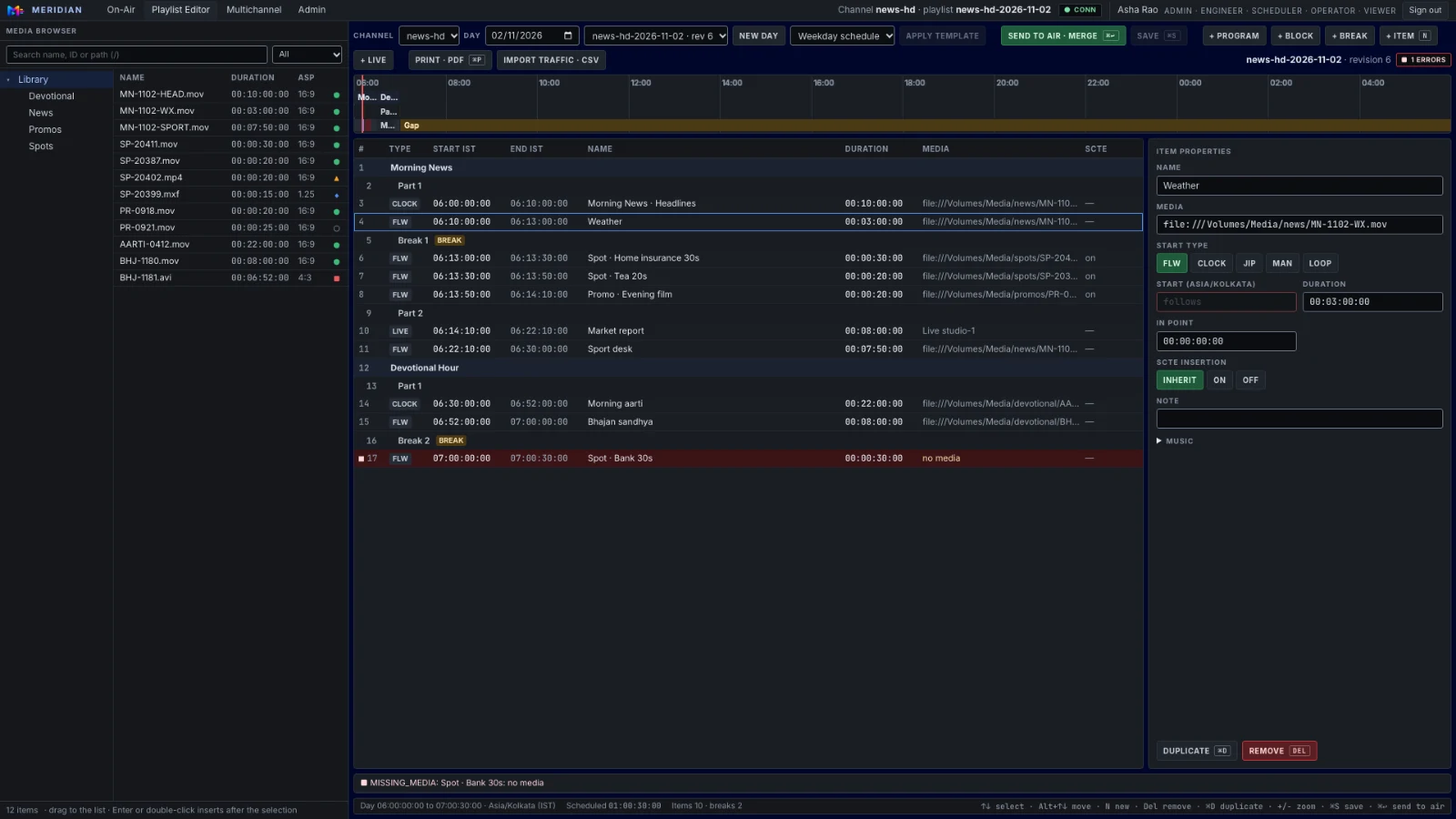
Meridian Playlist Editor: a media browser on the left, a day of programmes, blocks and breaks in the centre with a timeline above, and item properties including SCTE insertion on the right
Playlist Editor. Build the day from programmes, blocks and breaks, choose SCTE per block, and see missing media flagged long before air.
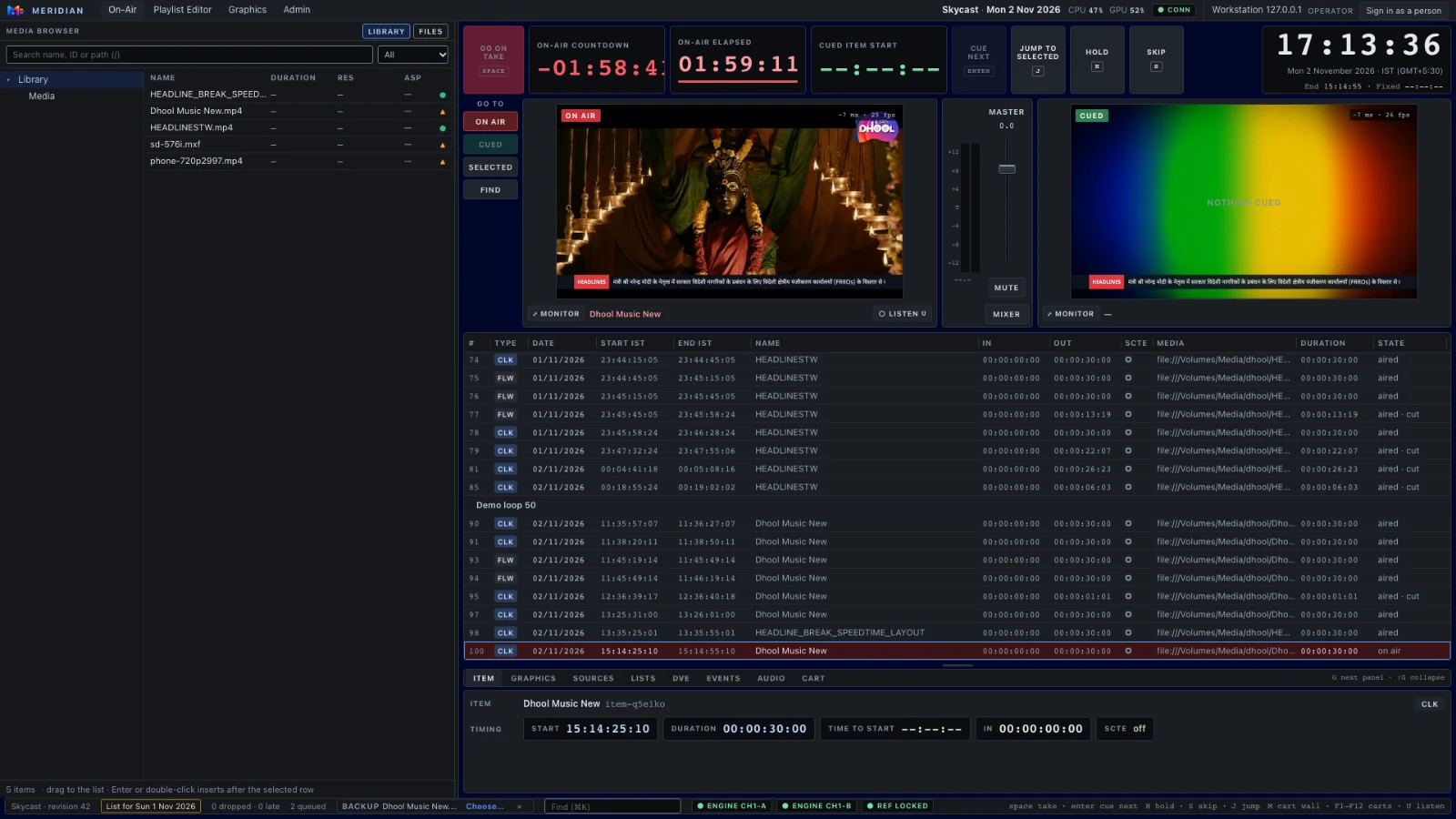
Meridian On-Air Control: the transmission list with the on-air and cued items, item timing, an SCTE-35 event and the audio faders
On-Air Control. The transmission list at the centre, with take, hold, skip, audio and SCTE all on the keyboard.
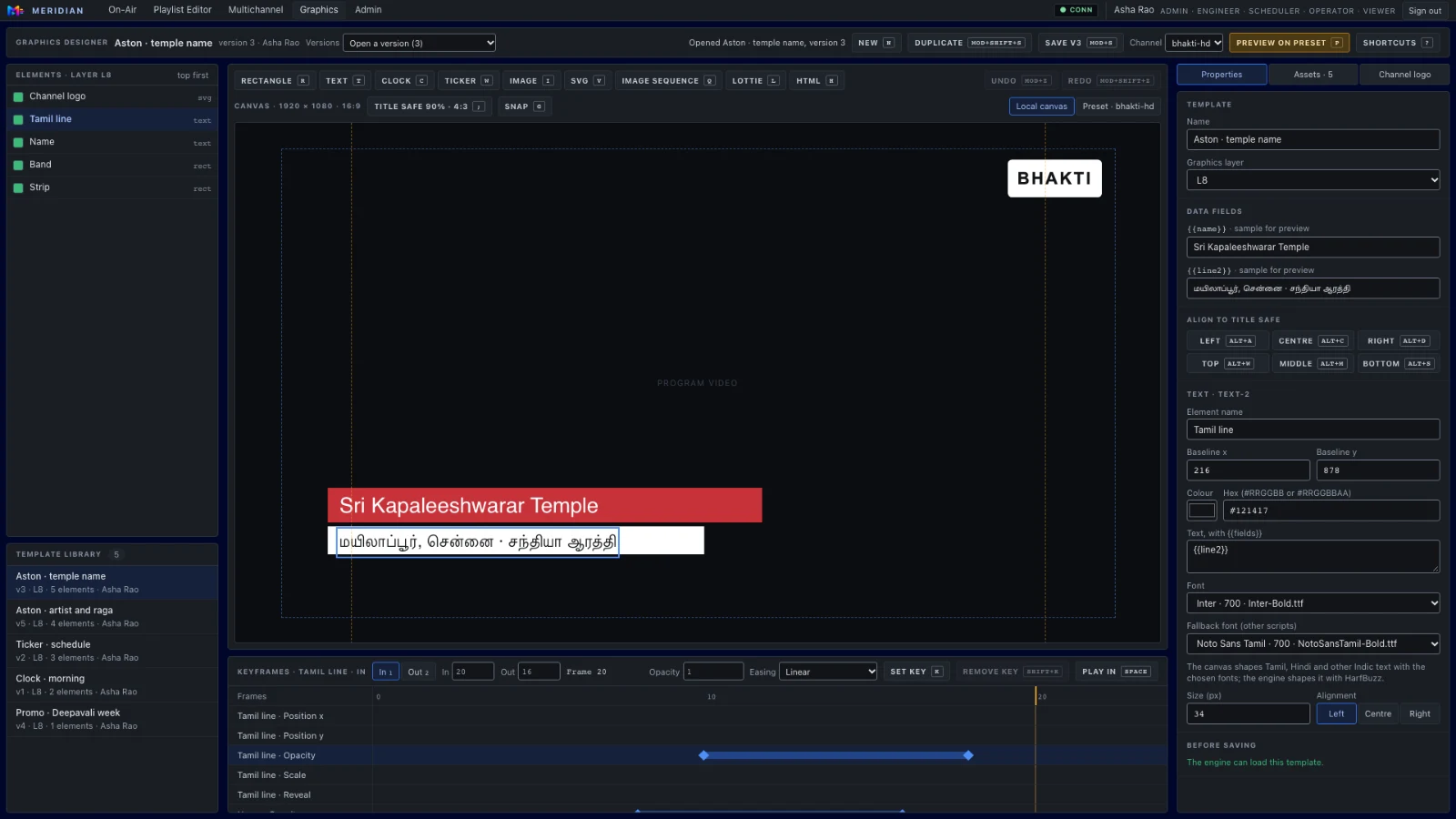
Meridian Graphics Designer: an Aston band with a Tamil second line on the canvas, keyframes below and template properties on the right
Graphics Designer. Design Astons, tickers and logos in the browser, with Tamil and Hindi shaped correctly.

GPU-resident pipeline

The frame never leaves the GPU.

On Apple silicon, the media engine, the GPU and the SDI path share one pool of memory. Meridian decodes, converts, composites and encodes right where the frame already is. Nothing is copied. Nothing waits.

  1. DecodeAny file or live source, in hardware where it can be
  2. NormaliseScale, aspect, frame rate and colour to the channel format
  3. CompositeLayers, transitions and graphics in 16-bit float
  4. EncodeHardware encode sessions for every stream
  5. OutputSDI and every stream, from the same rendered frame

One shared buffer in unified memory from decode to output. The processor never copies a frame.

Built on macOS

A whole playout chain.
On a Mac mini.

Meridian is built natively for macOS and Apple silicon, where the media engine, the GPU and memory live on one chip. That is why a channel can run on a Mac mini instead of a rack of servers, cards and fans.

  • 88% cheaper

    A Mac mini at about ₹80,000 instead of a ₹6,50,000 playout server. Grow to Mac Studio when you need more.

  • 87% less power

    65 W at most, against 500 W and more for a Core i9 and RTX 5070. A smaller UPS, less cooling, a lower bill.

  • 95% quieter

    5 dBA against about 50 dBA from a loaded rack server. Hear the programme, not the machine.

  • Steady, 24/7

    Cool-running hardware, one operating system tuned by one company, and a main–backup pair of Macs with automatic changeover. Built for channels that never go off air.

Meridian Playout on a Mac mini

Rock-solid, 24/7 on air.
For a fraction of everything.

A complete Meridian Playout channel runs on a Mac mini. Here is how that compares with a typical playout automation server built on an Intel Core i9 and an NVIDIA RTX 5070.

  • 88%cheaper
  • 87%less power
  • 98.4%less space
  • 95%quieter
Mac mini (M4)1Typical playout server
Price5₹80,000about ₹6,50,000
Power4 W idle, 65 W maximumCore i9-14900K up to 253 W plus RTX 5070 250 W, on an 800 W power supply2
Noise5 dBAabout 50 dBA under load3
Size12.7 × 12.7 × 5.0 cm (0.8 litres)4U rack chassis, 43 × 18 × 64 cm (49 litres)4
  1. Apple’s published specifications for Mac mini (2024) with M4: power measured at the wall, typical sound pressure at the operator position, and size.
  2. Manufacturers’ ratings for the Intel Core i9-14900K (253 W maximum turbo) and NVIDIA GeForce RTX 5070 (250 W total graphics power). A complete system draws more.
  3. Supermicro’s rating for a 4U server under high load. Perceived loudness roughly halves with every 10 dB, so a 45 dB gap sounds about 20 times, or 95%, quieter.
  4. A typical 4U rack chassis.
  5. Typical purchase prices in India.

Mac and Mac mini are trademarks of Apple Inc.

Everything a channel needs

One box owns what airs.

Frame-accurate engine

Timed to the frame, not the clock on the wall.

Every command names the frame it acts on, counted on the channel’s own clock. Two engines derive the same frame number for the same instant, so A and B act together, and every retry is safe.

Live inputs

Take anything live.

SDI from Blackmagic hardware, SRT as caller or listener, NDI, YouTube Live, RTMP, RTP and UDP transport streams, HLS and WebRTC, switched cleanly into the schedule.

SDISRTNDIYouTubeRTMPHLS

Graphics and tickers

Broadcast graphics, built in.

Logos, Aston bands, tickers, L-bands, clocks and countdowns on 16 layers, with correct Tamil and Hindi shaping and a browser template designer.

SCTE-35 and SCTE-104

Ad insertion, your way.

Choose cue insertion for the channel, then override it per programme or block. The as-run records exactly what was inserted.

Redundancy

Built not to blink.

Frame-locked main and backup engines. If the renderer stops, the output keeps its signal and shows the last good frame while it restarts.

Compliance recording

Proof of what aired.

A continuous recording of the programme with burnt-in timecode, kept for the retention you set, beside an as-run built from what the engine actually did.

Audience measurement

BARC watermarking support.

Support for Kantar’s licensed software embedder in the programme audio chain, so every output can carry the BARC India watermark.

Any file plays

No more transcoding first.

Every common broadcast container, codec, resolution and frame rate, normalised to the channel on the GPU. A readiness check flags trouble before air.

Control from anywhere on site

The transmission list is the centre of everything.

On-air control, playlist editor and multichannel wall in the browser. Every action has a keyboard shortcut, nothing on the air path opens a dialog, and the screen follows the engine within a frame. Nothing phones home.
Formats and protocols

If it plays anywhere,
it plays here.

Hardware decode where Apple silicon has it. Software decode straight into GPU memory where it doesn’t. Any size, any aspect, any frame rate, normalised to your channel in real time.

Video codecs

  • Apple ProRes
  • H.264 / AVC
  • HEVC / H.265
  • AV1
  • MPEG-2
  • XDCAM HD422
  • Sony IMX
  • HDV
  • AVC-Intra
  • XAVC
  • DNxHD
  • DNxHR
  • JPEG 2000
  • DV / DVCPRO
  • VC-1

Containers

  • MXF OP1a
  • MXF OP-Atom
  • MOV
  • MP4
  • MPEG-TS
  • MKV
  • WebM
  • AVI

Audio

  • PCM
  • AAC
  • MP2
  • MP3
  • AC-3*
  • E-AC-3*
  • Dolby E pass-through*
  • Opus
  • 48 kHz resampling

Frame rates and scan

  • 23.976
  • 24
  • 25
  • 29.97
  • 30
  • 50
  • 59.94
  • 60
  • 120
  • Variable frame rate
  • Interlaced and progressive
  • Sources up to 8K

Live in

  • SDI
  • SRT caller and listener
  • NDI*
  • YouTube Live
  • RTMP and RTMPS push
  • RTP and UDP TS
  • Multicast
  • RTSP
  • HLS
  • DASH
  • WebRTC (WHIP)

Out, all at once

  • SDI with embedded audio
  • SRT
  • UDP and RTP TS
  • RTMP and RTMPS
  • YouTube Live
  • Facebook Live
  • NDI*
  • HLS
  • WebRTC preview (WHEP)
  • Compliance recording

* Dolby and NDI need their own licences from Dolby and NDI. Codec and protocol support depends on the source being a valid stream.

Technical specifications

The details.

Download the Meridian Playout spec sheet (PDF)

Playlist and scheduling

  • Playlist, programme, block and item, with placeholders that resolve to media later
  • Fixed-time, follow-on and manual starts, with join-in-progress when a fixed event starts late
  • Automatic gap and overlap fill with a filler clip or loop, so nothing ever goes to black
  • Edit the list on air: trim, reorder, insert, skip, jump and hold
  • Recurring schedule templates generated weeks ahead
  • Media readiness checks at load, a day ahead and a minute before air
  • Traffic import and export in CSV and BXF, EPG export, print and PDF

Engine

  • Frame-accurate. Every command targets a frame on the channel clock (SMPTE ST 2059-1 epoch)
  • GPU-resident: decode, normalise, composite and encode in unified memory, with no frame copied by the processor
  • Hardware decode and encode through VideoToolbox; software decode into GPU memory for everything else
  • Metal deinterlace and re-interlace, AFD-aware scaling, frame-rate conversion and BT.709/BT.601 colour
  • Programme, Preset and Clean buses; Clean feeds archive and OTT re-branding
  • Transitions: cut, mix, dip to black or colour, wipes, stingers and 2D DVE
  • Simulcast: HD 16:9 and SD 4:3 outputs from one channel at once
  • House format ProRes 422 HQ, encoded and decoded by the Apple media engine

Video formats

  • SD 576i50 at 4:3 or 16:9 anamorphic
  • HD 720p50, 1080i50 and 1080p50
  • Per-output format, with AFD choosing centre-cut, letterbox or pillarbox
  • 16-bit float RGBA compositing, ready to carry UHD and HDR later

Live

  • Live items in the playlist, timed or open-ended, with a trigger to leave live
  • Live-source watch: hold a slate until a stream goes live, join it, retry on a drop
  • One-button breaking-news interrupt that returns to the schedule in step
  • Manual mode with a cart wall of clips and lives beside the timeline
  • YouTube Live re-broadcast where the stream’s owner permits
  • Live input to output in four frames or less (design target)

Graphics

  • 16 layers rendered inside the engine on the GPU, so every output carries identical graphics
  • Logos and watermark bugs, Aston bands, tickers and rolls, L-band squeeze, full-screen promos
  • Clocks, countdowns, stopwatches, sponsor and QR panels
  • Data-bound text from RSS, JSON, CSV, spreadsheets or the playlist (now and next)
  • HarfBuzz shaping for Tamil, Hindi, Telugu, Kannada, Malayalam, Bengali and Urdu
  • Per-field motion on interlaced outputs, so crawls never judder
  • Browser template designer; PNG, SVG, video with alpha and Lottie animation
  • External graphics keyed inside Meridian, so the output is final

Audio

  • 64-channel router per channel, 16 embedded channels per SDI output
  • Per-item audio profiles, up- and down-mix, track shuffle and language substitution
  • EBU R128 measurement at readiness, live loudness meters, output limiter
  • Ducking and voice-over as secondary events
  • AC-3 and E-AC-3 encode and decode, Dolby E pass-through, by Dolby licence
  • BARC/Kantar watermarking support through Kantar’s licensed software embedder

Ads and signalling

  • SCTE-35 on transport-stream outputs and SCTE-104 in SDI VANC
  • On, off or inherit per channel, programme and block, recorded in the as-run
  • Incoming SCTE-35 and SCTE-104 on live inputs as break triggers
  • Master and breakout channels for regional ad opt-out
  • AFD on every SDI output; per-spot as-run for reconciliation

Captions and subtitles

  • EIA-608 and 708 closed captions from files and live inputs to SDI and TS
  • OP-42 and OP-47 teletext, carried through or inserted from STL, SRT, TTML or EBU-TT

Redundancy and resilience

  • Main and backup engines locked to the same frame, with automatic changeover
  • An output keeper holds SDI and the clock steady; a renderer restart shows the last good frame, then the slate
  • Missing-media protection: a producer that cannot deliver falls back to the slate
  • Compact tier: A and B on one Mac where budget matters

Compliance and monitoring

  • Continuous compliance recording of Programme or Clean, with burnt-in timecode and set retention
  • As-run built from engine events, never from samples
  • Alarms, metrics over OpenTelemetry, and an audit trail of every change
  • Sub-second WebRTC preview of Programme and Preset in the browser
  • Nothing phones home unless you set an endpoint

Control and integration

  • Browser apps: On-Air Control, Playlist Editor, Multichannel Wall, Graphics Designer, Admin
  • Keyboard-first; nothing on the air path opens a dialog
  • REST, gRPC and WebSocket APIs with OpenAPI
  • RS-422 Sony 9-pin, VDCP and GPI/GPO over IP
  • MOS 2.8 gateway for newsroom systems such as Neo
  • Router control and HTTP webhooks as secondary events
  • Roles and permissions, LDAP and Active Directory sign-in, HTTPS throughout

Platform

  • Native macOS on Apple silicon, from Mac mini to Mac Studio
  • SDI through Blackmagic Desktop Video and UltraStudio over Thunderbolt
  • One engine process per channel, mutual TLS between control and engine
  • Signed, notarised installer; perpetual licence
  • Design targets: under two processor cores per HD channel, cold start to air under 30 seconds

Specifications describe Meridian’s design and may change as the product develops. Dolby, NDI and Kantar components need licences from their owners. Mac, Mac mini, Mac Studio and macOS are trademarks of Apple Inc. All product names are trademarks of their respective owners.

Your channel. Frame perfect.

Tell us about your channel. We’ll show you Meridian running it.

contact@skycast.in